For a hospital, getting impanelled is not just another form-filling exercise. It can connect the facility with government beneficiaries and private insurance networks while creating a structured route for cashless services and claims. Understanding the hospital empanelment process in India is therefore important for hospital owners and administrators. A Healthcare Consulting Firm in Delhi NCR, such as Nexa Health Consult, can help hospitals understand documentation, compliance, credentialing, and payer requirements without turning the process into a paperwork maze.
What Is Hospital Empanelment?
Hospital empanelment means a hospital gets approved or contracted by a government scheme, insurer, TPA, or other healthcare payer to provide specified medical services under defined terms.
The exact process depends on the organization. PM-JAY, for example, uses the Hospital Empanelment Module (HEM), where healthcare providers register and submit information for review. The State Health Agency then handles verification and approval according to the applicable process.
For private insurers, the process generally revolves around becoming a network provider. IRDAI explains that cashless treatment is offered through network providers that have an agreement with the insurer.
In simple terms, empanelment connects three moving parts: the hospital, the payer and the patient. If one part is poorly prepared, the whole process can slow down.
Why Empanelment Matters for Hospitals
A well-managed healthcare facility empanelment process can improve access to patients who use government schemes or insurance coverage. It can also support a hospital's trusted healthcare network, provided the hospital maintains the standards and contractual requirements attached to that network.
Empanelment also involves much more than getting an approval letter. Hospitals need to maintain documentation, clinical records, billing systems and compliance requirements after onboarding.
That is where hospital network onboarding and healthcare provider credentialing become important. Hospitals may need to demonstrate their infrastructure, manpower, specialties, registrations and other information during the credentialing process.
Also Read: Common Mistakes Investors Make When Setting Up a Healthcare Facility
PM-JAY Hospital Empanelment
The Pradhan Mantri Jan Arogya Yojana (PM-JAY), administered nationally by the National Health Authority, uses an established process for hospital empanelment. The NHA guidelines state that healthcare providers register through the Hospital Empanelment Module and submit a detailed application. Verification can include document scrutiny and physical inspection.
The application covers areas such as hospital information, infrastructure, specialties, manpower, licences and financial details. The NHA's operational material also describes the HEM as a platform for registering and subsequently updating hospital information.
Hospitals should therefore prepare their records before starting the application. Accurate information about available specialties, infrastructure and licences can make the hospital credentialing process more organized.
The National Health Authority IT Platform also supports the digital side of the process. NHA documentation explains that facilities may need to link their facility information with the HEM system.
CGHS Empanelment
The Central Government Health Scheme (CGHS) operates through a defined network of healthcare organizations for eligible beneficiaries. Hospitals seeking CGHS-related empanelment should check the current requirements and applicable empanelment notice rather than relying on an old checklist.
The process can involve scrutiny of hospital credentials, available services, infrastructure, documentation and applicable rates. The Ministry of Health and Family Welfare publishes CGHS-related information and lists of impanelled healthcare organizations.
For hospital administrators, the practical lesson is simple: keep registrations, licences, specialty information, financial details and supporting documents organized before beginning hospital network registration.
ESIC Hospital Empanelment
The Employees' State Insurance Corporation (ESIC) can enter into arrangements with private bodies for providing medical treatment to insured persons and their families under the applicable framework.
ESIC's current empanelment notices also show that the route can vary according to the availability of government, PM-JAY, CGHS or other eligible healthcare organisations in a particular area. Where additional facilities are required, ESIC may invite private hospitals to apply through an expression-of-interest or other prescribed process.
This makes Healthcare Management Consultants Noida and similar specialist support useful for hospitals that need to understand which route applies to their location and service category.
Private Insurer and TPA Empanelment
Private insurance empanelment usually focuses on creating a health insurance provider network. The hospital may undergo credentialing, document verification, commercial discussions and contractual onboarding before becoming an insurance network hospital.
The hospital and insurer or TPA may agree on service terms, packages and billing arrangements. This can include an insurer-hospital tie-up, hospital agreement with insurers, and discussion around a hospital rate contract.
IRDAI confirms that insurers and TPAs use network providers for cashless services and that cashless treatment depends on the applicable policy terms and pre-authorization.
This is why hospitals should not look at insurer rate negotiation as merely a commercial discussion. The agreed rates and service conditions can affect billing, patient communication and claims administration.
What Documents Should Hospitals Prepare?
There is no single universal document list for every payer. However, hospitals should maintain an organized repository covering:
Hospital registration and statutory documents
PAN, GST and applicable legal documents
Doctor and professional registration details
Specialty and service information
Bed and infrastructure details
Equipment and facility information
Applicable licences and certificates
Biomedical waste and other statutory compliance records
Bank and financial details
Quality and accreditation documents, where applicable
NABH standards cover areas including patient care, medication management, patient rights, infection control, facility management, human resources and information management.
Accreditation is not a substitute for every payer's requirements, but organized quality systems can support a hospital's overall healthcare provider credentialing and compliance readiness.
The Hospital Empanelment Process in India: A Practical View
Although every payer has its own rules, the broad journey often looks like this:
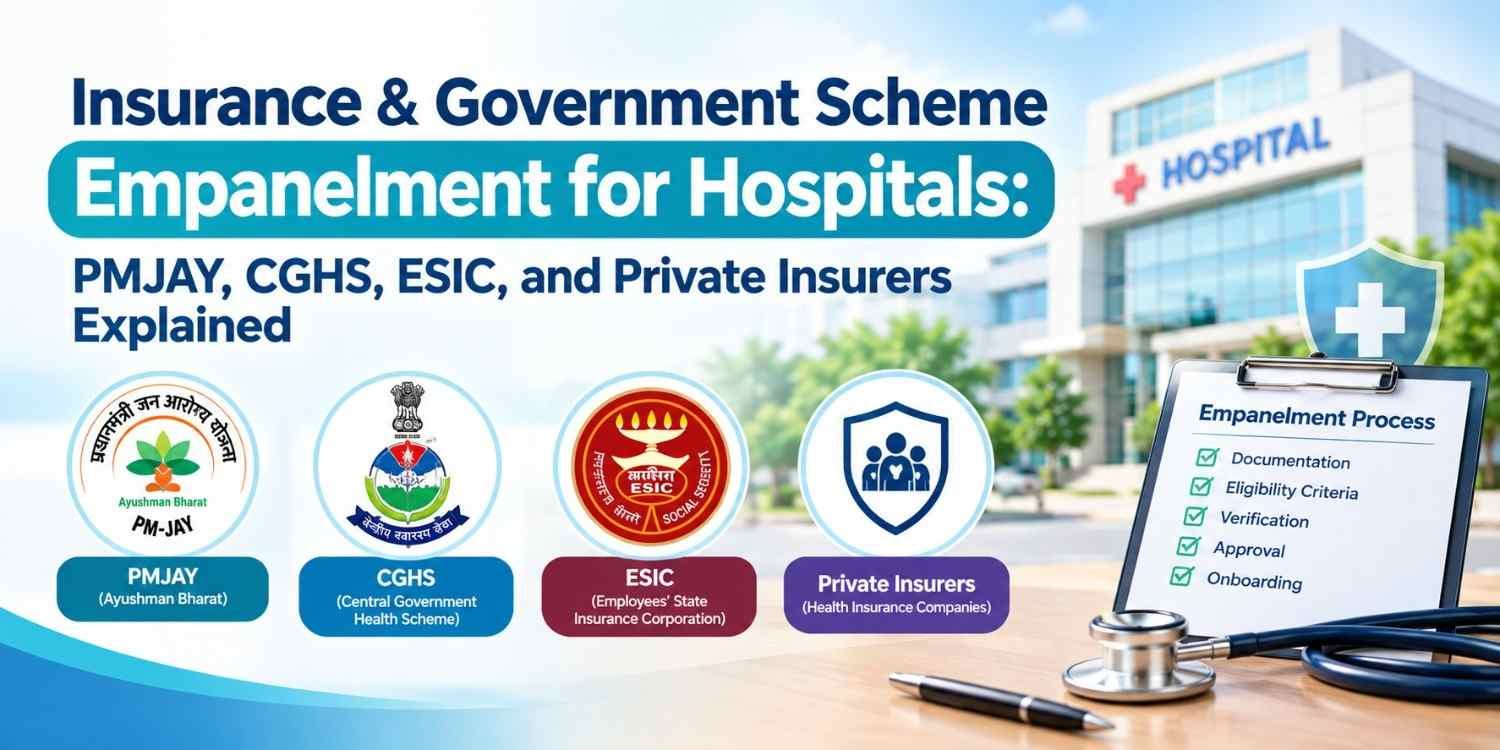
Eligibility check → Document preparation → Application → Scrutiny → Inspection or credentialing → Deficiency correction → Approval → Agreement/onboarding → Cashless operations → Claims and ongoing compliance
The work does not end after approval. Hospitals must continue managing authorizations, medical documentation, billing, claims and payer queries.
For private insurance networks, IRDAI also recognizes the importance of agreements between insurers/TPAs and network providers for cashless services.
How Nexa Health Consult Can Support Hospitals
A structured approach can reduce avoidable confusion during the hospital onboarding process. Nexa Health Consult can position its support around practical areas such as documentation readiness, payer coordination, empanelment preparation and process management, without treating every insurer or government scheme as if it follows the same rulebook.
For hospitals in the NCR region, hospital consulting services Delhi NCR can also help management teams bring administrative, clinical and financial stakeholders onto the same page before submitting applications.
What Happens After Empanelment?
Empanelment should be treated as an ongoing responsibility rather than a one-time achievement.
Hospitals need processes for streamlined billing, accurate documentation, pre-authorization, claim submission and query management. Strong internal coordination can support efficient claims management, transparent reimbursement and a better patient experience.
For private insurance, the difference between network and non-network treatment also matters. IRDAI notes that reimbursement may be available subject to policy terms, while cashless treatment is linked to network providers and approved pre-authorization.
That distinction should be explained clearly to patients. A good insurance desk should make the process feel less like a treasure hunt for paperwork and more like a predictable healthcare service.
Hospital Empanelment Process in India: Key Takeaways for Hospitals
The hospital empanelment process in India varies across PM-JAY, CGHS, ESIC and private insurers. Each payer can have different eligibility criteria, documentation, rates, agreements, verification methods and operational requirements.
The safest approach is to verify the current rules directly with the relevant authority or insurer before applying. Hospitals should prepare their documents, strengthen internal billing and records processes, understand payer-specific requirements and plan for ongoing compliance.
With the right preparation, hospital network onboarding becomes a structured administrative process rather than a last-minute scramble. Nexa Health Consult can support hospitals with empanelment preparation, documentation, credentialing, payer coordination and related healthcare management requirements.
Looking for professional guidance with your hospital empanelment or insurance network onboarding? Contact Nexa Health Consult to discuss your hospital's requirements and take the next step with a structured, compliance-focused approach.