Delhi vs Noida vs Gurugram: Why Hospitals in the Same NCR Region Follow Three Different Licensing Systems
If you are researching hospital licensing rules Delhi NCR, one fact can make the entire process feel surprisingly complicated: Delhi, Noida and Gurugram sit next to each other, but hospitals in these three locations do not follow exactly the same primary registration framework. For hospital owners, this difference matters from day one.
The hospital registration process, documentation, registering authority and regulatory pathway can change when you cross a state or Union Territory boundary. This is where professional guidance such as Hospital Consulting Delhi NCR can help make the compliance pathway easier to understand.
The reason is simple: NCR is a regional economic area, not a single healthcare regulatory jurisdiction.
Why NCR Does Not Have One Hospital Licensing System
The first thing to understand is that India's healthcare licensing framework combines central legislation with state-level implementation.
The Clinical Establishments (Registration and Regulation) Act, 2010 was created to provide registration and minimum standards for clinical establishments. The Ministry of Health and Family Welfare states that the Act applies in several states and Union Territories, but specifically excludes the NCT of Delhi. Uttar Pradesh and Haryana are among the states that have adopted the Act.
That single distinction creates much of the regulatory difference across NCR.
Under the central framework, a clinical establishment must be registered, meet prescribed conditions and maintain relevant records and reporting. The Act also provides for state councils and district registering authorities.
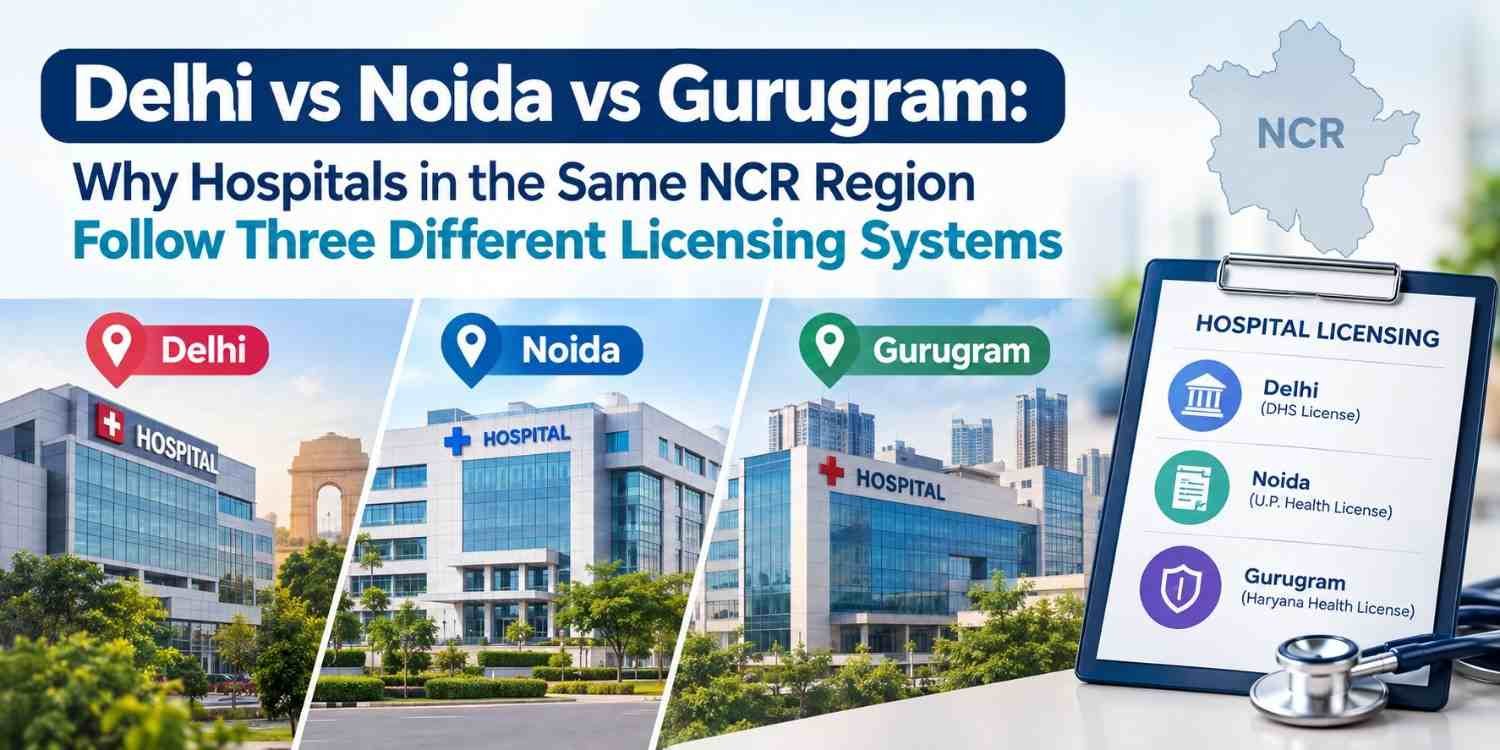
Delhi follows a different route for private hospitals and nursing homes. Its Nursing Home Cell Delhi, operating under the Directorate General of Health Services Delhi, handles registration and renewal under the Delhi Nursing Homes Registration Act, 1953 and its rules.
So, the first lesson is worth remembering: same NCR map, different regulatory map.
Delhi: The Nursing Home Registration Route
Delhi's system has a distinct legal foundation.
The Delhi Nursing Homes Registration Act 1953 governs the registration of qualifying private nursing homes and hospitals. The Delhi DGHS says its Nursing Home Cell was established specifically to register private nursing homes and hospitals under this Act and the rules made under it. It also carries out inspections and processes registration renewals.
The current Delhi DGHS information says the Nursing Home Cell registers private hospitals and nursing homes that operate around the clock, have indoor admission facilities with at least two beds, and practise modern medicine.
The regulatory history also includes amendments to the rules, including the Delhi Nursing Homes Registration Rules 2011. Delhi's official annual report records the Nursing Home Cell's responsibilities for application scrutiny, documentation, inspections, registration certificates, renewals and action involving registered establishments.
This makes Delhi's model noticeably different from the Clinical Establishments Act route used by neighbouring states.
For a hospital planning medical establishment registration in Delhi, understanding the applicable category and Delhi-specific requirements is therefore essential. The relevant hospital registration authority is not simply the same authority used in Noida or Gurugram.
Also Read: How to Open a Hospital in India: Complete Step-by-Step Guide (2026)
Noida: Uttar Pradesh's Clinical Establishment Framework
Cross into Noida and the regulatory picture changes because Noida is in Uttar Pradesh.
The Ministry of Health and Family Welfare lists Uttar Pradesh as having adopted the Clinical Establishments Act, with the adoption date recorded as 12 July 2016.
The central Act establishes a structured system for clinical establishment registration. It provides for provisional and permanent registration, conditions for registration, inspection, renewal and maintenance of registers.
For hospital operators, this creates a different compliance pathway from Delhi. The applicable clinical establishment act, state rules, documentation requirements and registration authority must be considered together.
This is where hospital consulting in Noida can become relevant for organisations trying to understand the local regulatory requirements before committing resources to a new facility or expansion.
The important point is not that Noida has “more” or “less” regulation than Delhi. The systems are simply structured differently. Calling every requirement a “licence” can hide that distinction and make the hospital registration process harder to understand.
Gurugram: Haryana's Version of the Framework
Gurugram sits across the border in Haryana, which has also adopted the Clinical Establishments Act.
The Ministry's official state notification page records Haryana's adoption date as 9 April 2018.
Haryana's Health Department provides its own implementation framework, including online registration and a District Registering Authority. The authority includes the Deputy Commissioner as chairperson and the Civil Surgeon as convenor, along with other district-level members.
Haryana also publishes registration fees based on the category of clinical establishment. For example, the department lists ₹2,000 for provisional registration and ₹8,000 for permanent registration for clinical establishments with 51–100 beds. For establishments with 101–300 beds, the published figures are ₹3,000 and ₹12,000 respectively.
These figures illustrate why hospital owners should check the jurisdiction-specific rules instead of relying on a generic “healthcare licensing in India” checklist.
The Healthcare Management Consulting in Noida perspective is useful here too because healthcare projects often involve more than the primary clinical registration. Owners need to map the relevant statutory obligations and approvals for the particular site and facility.
Delhi vs Noida vs Gurugram: What Actually Changes?
The biggest difference is the regulatory framework, not simply the city name.
The Ministry confirms that the Clinical Establishments framework provides for a National Council for Clinical Establishments and state-level structures, while the Act establishes district registering authorities for registration.
This is the heart of the licensing disparity across NCR.
Why This Creates a Compliance Burden for Hospitals
For a hospital operator, regulatory complexity rarely comes from one form.
It comes from putting the right form, authority, facility category and supporting document together at the right stage.
A hospital project may involve clinical establishment registration alongside other hospital permits and approvals and statutory requirements. The exact requirements depend on the facility, services, location and applicable laws. That is why a generic checklist copied from another city can create documentation gaps or unnecessary work.
The Delhi DGHS annual report gives a useful example of the administrative complexity involved. The Nursing Home Cell handles application scrutiny, deficiency letters, show-cause notices, personal hearings, inspections, certificates, renewals and cancellations. As of 30 April 2024, it reported around 1,193 nursing homes with 29,884 beds either registered or under registration/renewal.
The numbers also show why healthcare compliance is an ongoing process rather than a one-time formality.
What Hospital Owners Should Check Before Applying
Before starting registration, hospital owners should first identify the correct jurisdiction and establishment category.
Then build a compliance map around:
The applicable healthcare regulations Delhi NCR jurisdiction.
The correct hospital registration authority.
Clinical establishment registration or Delhi nursing-home registration, as applicable.
Required documentation and facility information.
Inspection and renewal requirements.
Other statutory approvals relevant to the facility and its services.
Any state-specific regulatory requirements.
This approach provides better legal clarity than starting with a long list of licences and trying to work backwards.
For organisations working across NCR, Healthcare Management Consulting Delhi NCR can help structure the regulatory review around the actual location and facility rather than treating Delhi, Noida and Gurugram as interchangeable markets.
How Nexa Health Consult Fits Into the Picture
This is where Nexa Health Consult can provide a practical starting point for organisations evaluating hospital setup, registration and compliance requirements.
The value of professional Healthcare Consulting Delhi NCR is not in making the regulations sound complicated. It is in making the applicable pathway easier to understand: which jurisdiction applies, which registration framework is relevant, what documentation needs attention and where additional regulatory requirements may enter the project.
The goal should always be straightforward: understand the applicable rules before investing time and money into an avoidable compliance problem.
Planning a Hospital in Delhi NCR? Start With the Right Regulatory Roadmap
Before you begin the hospital registration process, make sure you understand which regulatory framework applies to your location and what approvals your facility may require.
Connect with Nexa Health Consult for professional guidance on hospital licensing, registration, regulatory compliance and healthcare project planning across Delhi, Noida and Gurugram. Get clarity on the applicable requirements before you invest time and resources in the wrong process.
Start your hospital project with the right compliance roadmap, not a last-minute scramble.